
Trying to Decide If a High-Volume Oil Pump is Right for Your Build?
Published by Steve Koch, Northern Auto Parts on May 27th 2026
You're halfway through a small-block build, and someone at the parts counter (or on a forum thread) tells you to throw in a high-volume oil pump. It's not expensive. It sounds like an upgrade. And hey, more oil flow has to be better, right?
Not always. That's the short answer, and it's the one that saves you from chasing a problem you didn't have in the first place.
A high-volume pump moves more oil per revolution than a stock unit. That's useful when your engine genuinely needs it…and a waste of time when it doesn't. The difference comes down to what's actually happening inside your build: bearing clearances, RPM range, whether you've got remote filters or a cooler in the mix, and forced induction pulling extra demand. Get those details right, and the pump choice becomes pretty obvious.
What Does a High-Volume Oil Pump Actually Do to an Engine?
The name does most of the talking, but it's worth being precise about what "high volume" actually means in practice. A high-volume pump moves more oil per revolution than a stock unit. It does not generate additional pressure on its own, nor does it compensate for a tired engine that's leaking pressure through worn bearings or a neglected oiling system.
The pump's job is to meet the engine's oil demand. When demand goes up, the stock pump may not have enough capacity to keep up, and that's where a high-volume unit steps in. It's a flow problem, not a pressure problem, and the fix has to match the actual issue.
Think of it this way: a stock pump is sized for a stock engine. The moment you start changing clearances, adding RPM, or bolting on components that pull more oil through the system, the math changes. The engine needs more oil moved through it per revolution, and a pump that wasn't built for that demand will eventually show you the gap on the gauge.
That said, dropping in a high-volume pump on a basically stock build does not buy you extra protection. It just means you're moving more oil through a system that wasn't asking for it. The pump does its job either way. The question is whether the engine actually needs what it's offering.
Which Engine Builds Actually Need a High-Volume Oil Pump?
A high-volume pump is for engines with greater oil demand than the stock pump can handle. That demand comes from specific changes to the build, not from a general desire to run more oil through the system. There are four situations where a high-volume pump stops being optional and starts being the right call.
The first is increased bearing clearances. When you open up clearances beyond stock spec, the engine needs more oil volume to fill those gaps and keep the surfaces properly lubricated. EngineLabs makes a useful point here: at wider clearances, volume matters more than pressure alone. You can throw pressure at the problem all day, but if the pump isn't moving enough oil to occupy those clearances, you're still falling short.
Higher RPM operation is the second. The faster an engine spins, the faster it burns through its oil supply. A stock pump is sized for a stock RPM range. Push past that, and the demand climbs faster than the pump can keep up.
The third situation involves remote filters or external oil coolers. Any time you add length or components to the oiling circuit, you're asking the pump to work harder to push oil through the system. More plumbing means more resistance, and more resistance means you need more flow to maintain delivery where it counts.
Forced induction is the fourth. Turbochargers and superchargers increase oil consumption. The turbo needs oil for bearing lubrication, and that draw on the system has to be accounted for somewhere. A stock pump wasn't designed to handle that extra load.
If your build doesn't check any of these boxes, the stock-volume pump is probably still the right answer.
When Should You Stick With a Stock-Volume Oil Pump?
The temptation to upgrade every component in a build is real, and oil pumps are no exception. More volume sounds like more protection, and that logic is hard to argue with until you actually look at what the engine needs.
An engine without increased oil demand should use a stock-volume pump. That's not settling. A standard-volume, standard-pressure replacement does exactly what it's supposed to do for a rebuild, staying close to factory spec, a street engine with stock clearances, or a driver that just needs the oiling system sorted out properly.
Where builders get into trouble is treating a high-volume unit as a default upgrade. The oiling system is a closed loop, and every component is sized to meet expected demand. Changing one part of that without changing the conditions that drive demand is not a performance move, and it won't show up as a gain anywhere that matters.
Why Do SBC Builders Choose the Melling M-55HV?
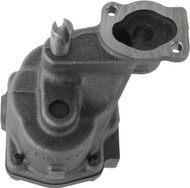
For Gen I small-block Chevy builds that have entered higher-oil-demand territory, the Melling M-55HV is a natural fit. Melling is known for it's quality, precise manufacturing. It delivers 25% additional volume over stock at standard pressure, which means the engine gets more oil moved through the system without the oiling circuit being thrown out of balance by an artificial pressure spike.
Fitment covers the common Gen I SBC family: 283, 305, 327, 350, and 400 cubic inch applications. That's a wide net, and it's a big part of why this pump shows up so often in SBC builds across the street and strip crowds.
The standard pressure spec is worth pausing on. A lot of builders assume high volume means high pressure, but that's not how the M-55HV works. The extra volume is there to meet increased demand, not to force more pressure into a system that wasn't built for it. That distinction matters when you're spec'ing out the rest of the oiling system.
One thing that catches builders off guard: the M-55HV requires an aftermarket steel intermediate shaft with a steel collar. The factory shaft with the plastic collar is not up to the job. This is not a minor detail to sort out later.
Northern Auto Parts offers a combo kit that bundles the pump with the correct steel shaft and pickup screen, taking the guesswork out of making sure everything in the system is matched properly. If you're going with the M-55HV, that's the version worth looking at.
Can a High-Volume Oil Pump Cause Problems If Used Wrong?
The short answer is yes, but probably not for the reasons you've heard. The usual forum concern is that a high-volume pump will push too much oil into the top end, drain the pan, and starve the engine. That particular boogeyman is mostly a myth. A high-volume pump will not pump the pan dry on its own if the drainback system is functioning the way it should.
The real problems come from a mismatched system, and they're less dramatic but more damaging.
A high-volume pump will not fix a worn engine. If low oil pressure is coming from worn bearings or a tired block, more flow is not the answer. The pump is moving oil through a system that can't hold it, and the gauge will keep telling you the same story no matter what's sitting in the timing cover.
Aeration is a more serious concern than most builders give it credit for. Oil that's been whipped into foam by the rotating assembly is not doing its job. The pump is designed to move liquid, and aerated oil hurts both delivery and heat control. Windage, poor pan baffling, and inadequate oil control are what put air into the system in the first place. The pump doesn't cause that problem, but it can't solve it either.
Cavitation is the other side of that coin. A pickup that's sitting too far from the pan floor, or too close, throws the whole system off. Most people will advise a pickup-to-pan clearance of 3/8 to 1/2 inch. Get outside that range, and the pump starts pulling air instead of oil, which is a fast way to turn a performance build into a teardown.
Weak drainback, poor pan design, and missing baffles are the actual culprits behind most high-volume pump failures. The pump did its job. The rest of the system wasn't built to handle what the pump was sending through it. That's a planning problem, not a parts problem.
Northern Auto Parts
Looking to give your engine a fresh start? Whether you’re diving into a complete overhaul or just swapping out some worn parts, having the right gear is crucial. Northern Auto Parts isn’t just another auto parts store — we’re here to help you keep your ride in top shape.
With over 40 years of experience, we know auto parts like the back of our hand. Northern Auto Parts is recognized by many as the best online source for rebuild components. Our engine kits cover a ton of makes and models, so you’re sure to find exactly what you need for your rebuild. And if you’re just after specific parts, we’ve got those too — pistons, gaskets, you name it. Don’t forget to check out our free auto parts catalog.
If you prefer, you can always give us a call during normal business hours. 1-800-831-0884