
How to Build Long‑Term Reliability When Doing a 1992–1993 Jeep 4.0L Rebuild
Published by Steve Koch, Northern Auto Parts on Nov 25th 2026
The 1992–1993 Jeep 4.0L came from the early High Output years, a period many Jeep owners still regard highly. A 1992 Cherokee with the 4.0L produced 190 hp at 4,750 rpm and 225 lb-ft of torque at 4,000 rpm. It’s for an engine with useful torque, simple construction, and a powerband suited to normal road or trail use.
Long service life has also shaped owner opinion of the 4.0L. Rebuild discussions often split into two camps. Some owners see an overhaul as a chance to build a stroker. Others prefer the stock displacement because reliability remains the main reason they kept the engine in the first place.
For a 1992–1993 rebuild, the strongest approach starts with the condition of the block and then moves into the correct parts package. Our catalog includes separate re-ring, block, cam, and master kits for these years.
How Do You Rebuild a 1992 Jeep 4.0 for Long-Term Reliability?
Start by deciding how much of the engine actually needs replacement. Compression readings, oil consumption, bearing condition, cylinder wear & valvetrain inspection can point toward a light refresh or a complete overhaul.
A stock-style rebuild has a strong case here. The early-HO 4.0L already delivers useful torque without high engine speed. Keeping compression and cam specs near the original range also keeps fuel requirements reasonable and preserves normal idle characteristics.
Machine work deserves more attention than performance add-ons during a reliability-focused build. Cylinder taper needs to be measured at several points in each bore. Crankshaft journals need actual micrometer readings. The connecting rods should receive inspection before new bearings go in.
Owner discussions back up this approach. Some Jeep enthusiasts recommend a stroker whenever a 4.0L comes apart. Others prefer stock displacement for regular street use and cite fewer variables in the finished engine. One rebuild discussion included a stock-displacement 4.0L with new internal parts after machine-shop work, which reflects a common route for owners who want the original engine back in proper condition.
What Parts Are Needed for a 1993 Jeep 4.0 Rebuild?
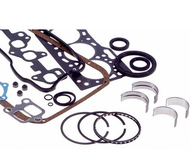
The answer depends on how much wear the teardown reveals. Our AMC 242 4.0L 1992–1993 Re-Ring Kit ER0025 contains piston rings, rod bearings, main bearings, and overhaul gaskets. It fits a rebuild where the existing pistons remain serviceable and the cylinder bores stay within usable limits.
A lower end with worn pistons calls for a broader package. Our AMC 242 4.0L 1992–1993 Block Kit OH90026 includes flat-top or dished pistons, piston rings, rod bearings, main bearings, a stock-volume oil pump & an overhaul gasket set. Northern Auto Parts specifically positions this kit for builders who need the lower-end overhaul components without a camshaft, lifters, or timing parts.
This is one reason Northern Auto Parts is one of the best online sources for Jeep 4.0 engine kits. Our 1992–1993 selection separates the rebuild into useful levels instead of forcing every engine into the same package.
What Comes in an AMC Jeep 4.0 Master Kit for Early 1990s Models?
Our AMC Jeep 4.0 1992–1993 Master Kit EK0026 covers a much larger portion of the engine.
The current kit contains a stock camshaft and lifters, along with a timing set and pistons. Piston rings and rod bearings are included, as are main bearings and cam bearings. The package also supplies an oil pump, frost plugs & an overhaul gasket set.
An AMC Jeep 4.0 master kit makes sense once inspection finds wear outside the short block. Cam lobes can wear after high mileage. Hydraulic lifters can lose proper operation. An old timing chain can add slack between the crankshaft and camshaft. Freeze plugs also become sensible replacements during a complete teardown because access is already open.
A block kit leaves those areas to the builder. The master kit brings most of the overhaul parts into one package. Neither route is automatically better. The engine’s condition decides which one fits.
Which Jeep 4.0 Rebuild Parts Have the Biggest Effect on Reliability?
Bearing clearance is high on the list. Fresh bearings still need the correct oil clearance against the crank journals. Too little clearance can cause heat and oil-film problems. Excess clearance can reduce pressure and shorten bearing life.
Cylinder finish has a direct effect on the new rings. A bore with excess taper may need machining rather than a basic hone. New pistons also need the correct piston-to-wall clearance for their design. This is where a good machine shop comes in.
The cylinder head needs its own inspection. Community technical references identify the 7120 casting as the head used on 1991–1995 4.0L engines, which covers the 1992–1993 applications discussed here. Check the head surface and valve condition during a full overhaul. A pressure test also makes sense when the engine has a history of overheating or coolant loss.
Oil supply rounds out the short-block work. OH90026 includes a stock-volume oil pump, and EK0026 includes an oil pump as part of the master package. A stock-volume pump fits the reliability theme well for an otherwise stock-style 4.0L. Proper bearing clearances and clean oil passages give the pump the conditions it needs.
Is It Better to Keep a 1992–1993 Jeep 4.0 Stock or Build a Stroker?
There is a real argument on each side.
A stroker uses a longer-stroke crankshaft to increase displacement. Jeep 4.0L builders commonly use the idea to gain torque, and enthusiasts have built many successful versions. A properly designed stroker can serve as a dependable street engine. Parts selection, compression ratio, machining, and tuning need to suit the combination.
Stock displacement removes several extra decisions. The original 4.0L already produced 225 lb-ft of torque in 1992 Cherokee trim, and its low-speed output works well for regular driving. For an owner whose first priority is long-term service, rebuilding the original configuration has plenty of merit.
Owner opinion reflects this split. Some Cherokee enthusiasts recommend stroker builds as soon as engine work becomes necessary. Others specifically prefer the stock 4.0L for daily use because they value its established service history and simpler combination.
A rebuild does not need more displacement to be worthwhile. Restored compression, fresh bearings, proper cylinder finish, and renewed valvetrain parts can make a worn 4.0L perform much closer to its original specification.
Where Can You Find the Right Jeep 4.0 Engine Kit for a 1992–1993 Rebuild?
Our AMC-Jeep 4.0L Engine Rebuild Kits are separated by year range. For 1992–1993, ER0025 covers the re-ring level, and OH90026 covers the lower-end rebuild. EC0027 handles cam-related work, with EK0026 available for the larger overhaul.
The year-specific 4.0L section also includes separate packages for 1987–1991, 1994–1995, and later engines. Confirming the correct production range keeps the parts search focused before piston and bearing sizes enter the order.
Builders often see Northern Auto Parts as one of the best places online to start an AMC-Jeep engine rebuild. We have supplied auto parts for more than 40 years, and our broader engine kits cover AMC-Jeep applications alongside many other domestic engine families.
Long-term reliability comes from a fairly traditional recipe on these early-HO engines. Inspect first. Let the machine work set the required sizes. Pick the kit level from the wear found inside the engine. A 1992–1993 Jeep 4.0L built around those decisions can keep the original qualities people still value in this engine.