
Valve Size Selection Tips for Building a Balanced Small Block Chevy
Published by Steve Koch, Northern Auto Parts on Feb 16th 2026
It’s tempting to start with the biggest number on the chart. Bigger intake valve. Bigger exhaust valve. The bigger the number, the more horsepower, right? That’s not always how it plays out. Valve size affects how air moves through the head, but the rest of the setup determines whether that airflow translates into real performance or just noise.
You’ve got to look at the whole combo. Bore size, cam lift, port shape, and combustion chamber geometry all affect what the bigger valve can actually do. Slap a 2.02 into a chamber that’s tight or shrouded, and you might choke flow right where you need it most.
Street builds don’t live at redline. They care more about throttle feel and midrange punch than what happens past 6,000 RPM. Valve sizing should match the engine's operating conditions, not just what looks good on a spec sheet. This is where balance beats bragging rights.
How Valve Size Changes Airflow and Horsepower
Valves act like doors for air and fuel. Open the door wider and more mixture can move, at least in theory. Diameter sets the ceiling for flow, though the rest of the head decides how much of that ceiling you actually reach. Cam lift, port volume, bowl shape, bore size… they all stack up. A large valve in a tight chamber becomes crowded, and crowded air slows down quickly. You feel that as a lazy throttle response or an engine that feels strong up top but soft everywhere else.
Cylinder walls and chamber edges matter more than people expect. When a valve sits too close to those surfaces, air hits a wall instead of rolling cleanly around the edge. That shrouding cuts into the flow right when the valve first opens. On a street motor, that early lift range does most of the work. Engines spend very little time at max lift, even during a hard pull.
Most horsepower gains come from improving mid-lift flow. Valve shape, seat angles, bowl work, port velocity… those details decide how well the cylinder fills between idle and redline. A balanced valve size keeps air moving quickly, cylinders filling evenly, and power delivered where you actually drive. That’s the difference you feel every time you crack the throttle.
Why 1.94/1.50 Valves Still Hit Hard on the Street
A 1.94‑inch intake with a 1.50‑inch exhaust has earned a solid reputation among street‑oriented small block Chevy builds because it balances airflow with real‑world engine behavior. That size keeps air moving at high velocity through the port and into the chamber, improving throttle response and midrange pull, where most street engines spend most of their time. Cars and trucks that live around town or cruise at highway speeds don’t hang out at peak RPM long enough to make oversized valves worth the trade‑offs.
Smaller chambers and mild cam lifts are compatible with this valve size. You avoid the shrouding that shows up when a valve sits too close to the cylinder wall or chamber edges, and that’s where most of your usable airflow actually happens. Too big, and instead of making the flow better, you just make the engine work harder to fill the same space. That’s the sort of thing you feel as flat throttle response or a lazy midrange pull.
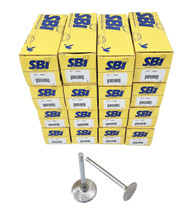
Northern Auto Parts carries the Small Block Chevy 1.94 and 1.50 Valve Set for builds that need solid everyday performance without overkill.
Where 2.02/1.60 Valves Start to Make Sense
There’s a point where the extra area that bigger valves offer actually pays off, but that point isn’t universal. A set like the SBC Stainless 2.02 Intake and 1.60 Exhaust Valve Set works best on heads with larger bores (e.g., 4.00″ and up) and chambers that can accommodate the added size without restricting flow at low lift. That matters because lots of street cams don’t make big lift numbers until high in the rev band. A bigger valve can be great up there, especially with a cam that pushes past 5,500–6,000 RPM.
Stainless valves with swirl‑polished faces and undercut stems are something you notice in the higher rev range. They resist heat and maintain their shape as RPM increases, which is why they appear in performance builds designed to spend more time breathing near the top. You can feel it in the power curve once the engine is turning and the ports are wide enough to use the extra area, the 2.02 intake and 1.60 exhaust let the engine fill the cylinder more completely.
This valve set fits that sort of use better than a stock‑sized set, especially on machines that see spirited driving and built heads rather than just daily‑driver duties.
Common Mistakes That Throw Off the Build
Bigger valves can seem like an easy upgrade. Until they aren’t. One of the most common mistakes is dropping 2.02-inch intakes into heads that were never meant for them. Without the right seat and chamber work, flow can actually *drop*, especially in the ranges where most engines live. Low-lift performance starts to suffer, and that crisp throttle feel gets lost in the shuffle.
A lot of camshafts designed for the street rarely see much above .500" lift. Even wilder profiles don’t keep the valve up there long enough to take full advantage of big-flow numbers. So if that oversized valve kills flow at .300" or .400", you’ll feel it. The heads can get lazier even if the top-end math looks good on paper.
There’s another angle too: cost. A bigger valve needs more machining. Skipping that step risks worse flow than the smaller valve you just replaced. A careful valve job, with good seat and bowl work, often gives better results than just chasing size. Matching the valve to the head is where the real gains are.
Why You Should Choose the Valve Size Last, Not First
The valve might be the star of the spec sheet, but it’s the wrong place to start a build. Before grabbing a bigger set, figure out where the engine’s going to live. If your redline never leaves the 5,500–6,000 RPM neighborhood, the airflow goals look a lot different than a build that spends its life up top.
Bore size matters. Smaller chambers and tight cylinder walls can choke off flow around the edge of a large valve. That’s valve shrouding, where your airflow potential just crashes into the wall. Bigger isn’t better when the head can’t breathe around it.
The camshaft lift range also plays a significant role. Most of your driving happens at low-to-mid lift. That’s where shape, seat work, and velocity matter. Not just diameter.
Machine work eats time and budget. Some heads take a 2.02 clean. Others don’t. Picking the right combo means stacking parts that match, not parts that just look good in isolation.
The Parts You Pick Should Match the Way You Drive
Every build has a personality. Some engines want to hit hard off idle and carry that punch through the midrange. Others don't wake up until the needle climbs. That’s why valve sizing has to match more than just the cylinder head; it's got to match how the car actually gets used.
A small block built for street pull and throttle feel doesn’t need huge valves. That’s where the 1.94/1.50 combo earns its keep. It keeps air moving fast, supports snappy response, and works cleanly with common heads and mild cams.
But if you’re building for revs (i.e., steeper gears, big cam, high lift), the bigger 2.02/1.60 combo starts pulling its weight. It gives the airflow headroom those builds need... as long as the heads, bore, and bowl work are ready for it.
Everything in the setup matters. The right valve doesn’t make the build; it just lets the rest of it work the way you planned.
Northern Auto Parts
Looking to give your engine a fresh start? Whether you’re diving into a complete overhaul or just swapping out some worn parts, having the right gear is crucial. Northern Auto Parts isn’t just another auto parts store — we’re here to help you keep your ride in top shape.
With over 40 years of experience, we know auto parts like the back of our hand. Our engine kits cover a ton of makes and models, so you’re sure to find exactly what you need for your rebuild. And if you’re just after specific parts, we’ve got those too—pistons, gaskets, you name it. Don’t forget to check out our free auto parts catalog.
So, get ready and get your engine back on the road with Northern Auto Parts—your go-to spot for quality engine parts and rebuild kits.
Alright, let's get this engine roaring.